Wednesday, April 13, 2011

Bariloche’s 4 Refugios: Not for the faint of hearted.

Period.

I was tempted to leave the blogpost here and let your imaginations run wild with the title alone, but sometimes the real stories are worth telling. I believe that this is such a story. It tells of miscalculated shortcuts and subsequent tree surfing; it features boxed wine and soaring Andean Condors; and the protagonists are none other than Matias, myself and the unpredictable uncontrollable unconquerable weather of a Patagonian autumn.

Bariloche is the trekking capital of my heart. It has a little bit of everything: from hop-skip-jump beginner treks for the city folks to knee-shaking-palm-sweating mountain-ridge traverses for the fearless fanatics. Everything from rolling forested hills with well-marked paths to dramatic jagged snowy peaks with ferocious howling wind (and tremendous views). Yes, Bariloche has it all.

One of my goals before leaving Bariloche was to do the 4 refugio trek, a circuit of four mountain shelters, or refugios, Frey, Jakob, Laguna Negra, and Lopez. I had heard that it would be tough, but I mean… how tough could it be?

Bariloche to Frey

We chose Cerro Catedral’s parking lot as the starting point. You have your options, but this is my favorite.

My worn trekking shoes already know the way to Frey from doing the trail so many times. They knew where to avoid the squishies, where to skip over the graspy hands of forest roots, where to run, where to wisely conserve precious energy. The only difference was that on this trek our backpacks were heavy, very heavy, prepared for five days in the mountains.

I found myself disappearing into my head, as is common on treks. Letting my feet carry me over the rocks, dirt, mud, roots, streams… my thoughts wandered ahead of me, soared over me, tripped under me. The mountain is great for sloooooowing down and dedicating time and energy to appreciating the things we are normally top busy or too in a hurry to pay any attention to.

We quickly passed from exposed path, to comforting forest, to tremendous mountain. And before we knew it, we marched up to our first refugio.


The stars were fierce that night. A perfect night. No wind. We bundled up against the autumn chill and, from the shelter of our tent, we cooked up an improvised rice dish typical of camping cuisine.


Familiar constellations smiled down and performed a welcome dance party. Welcome to the mountain, they sang.

Frey to Jakob

A week prior, I had done this trek with Sol, a friend and Canopy co-worker. Sol is not a mountain girl. She’s a city girl from Buenos Aires. This is not an easy trek. I’m very proud of her for toughing it out. I’ll include some of those pictures here as well.


As I mentioned, this is not a physically or mentally easy hike. After circling around Laguna Tontec, you head up. Straight up. Prepare your thighs, calves, and lungs. Because once you reach Laguna Schmoll, you can take a rest if you need it, but you’ve still got a climb to the cancha de fútbol.

At the top of the crest if it’s a clear day, you may graced by a snow-topped Tronador peaking across a valley.

Little do you know that you have to cross that valley and climb up the other side. So prepare your knees because it’s quite a rocky way down. The valley is home to forests, marshes, and quite acceptable campsites. But watch your step, it’s squishy!

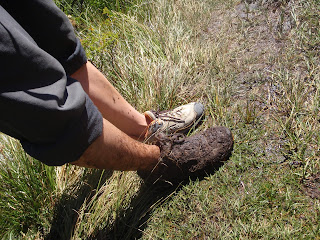
Another steep hike up leads to a breathtaking view. A view that includes, TADA!, Laguna Jakob and Refugio San Martin.

But don’t cheer just yet, it’s still a long long long rocky hike down. But it’s a beautiful feeling to make it!


Unlike the refugieros of Frey, the ones at Jakob are just that much more isolated from civilization. They are welcoming, warm, wonderful, and willing to supply you with water for mate. Jakob is less commercial than Frey; it’s not as far down the road to selling out. And the bathrooms are better.

Jakob to Laguna Negra

Ah. The famous Jakob to Laguna Negra stretch. I had never done this one, but I had heard about it. This is the tough one, they all told me. And they are right. This is the one that requires the most mental and physical strength. This is the one that everyone everyone everyone gets lost on. Yes, everyone.

The morning we were supposed to embark for Laguna Negra, the odds were against us. Wind. Lots of wind. Drizzle. Rain. More wind. And… due to said wind, Matias’s tent pole snapped in half. As I evaluated all the contributing factors, I was convinced that we would be heading back down to Bariloche that day. My goal of doing all four refugios would have to wait until who-knows-when. The next trip to Bariloche, if there ever is one. That really sucks. My face wore a frown.

And while I was pouting away, Matias fixed the tent pole (have I mentioned that Argentines can fix anything? Anything.) and we decided to chance it. The refugiero said he would radio to Laguna Negra that night to confirm that we had made it. We set off.
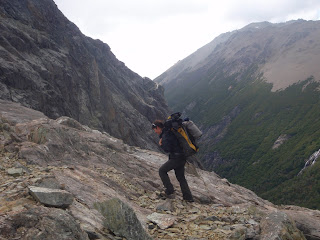

With our faces bent into the wind, we climbed and walked and grasped and gasped and staggered and swaggered for hours and hours. Yes, we got lost. Yes, it is a very very very difficult trek. Yes, there were a few times that I honestly feared for my life. But was it worth it? Yes, yes it was.

The wind was the exhaustingly present the entire trek. Especially at the top!


But here’s where it gets interesting. Any worried family members may want to stop reading here.

Arriving to Laguna Negra one comes across a very long very steep very winding path. Anyone familiar with Laguna Negra will shudder at the mere mention of “el caracol” or “the snail”. The refugiero back at Jakob had told us of an alternative path, a shortcut, and we jumped at the opportunity to avoid the caracol. As we were approaching Laguna Negra, leg-shakingly exhausted with soaking wet sneakers, Matias announced that he thought he’d found the shortcut. We left the main trail and started climbing. Soon the climbing became extremely vertical. I’d never considered rock climbing an extreme sport… until this moment. The rock we were climbing was slick from the mist that had started falling again. We climbed up up up and soon it became increasingly important that we didn’t fall. With no harnesses, ropes, or gear, one foot slip, one miscalculated hand grip, one loose rock would be bad, very very bad. And with the whole day’s exhaustion, the ever fading daylight, heavy trekking backpacks and slippery sneaker soles…

And on top of it all, I mistakenly went left instead of following Matias right. Subsequently, I found myself hanging on for dear life to the slender, but resilient branches of Lenga trees as my feet swung below me kicking at near vertical slippery soil.

It is very important in this situation not to freak out. Anyone familiar with rock climbing knows this. Once you entertain the idea of falling, your body suddenly enters into a state of paralyzed fear. You can’t move up or down or sideways. You are consumed with this fear. Suddenly your hands overgrip, your legs shake uncontrollably, you tire yourself out. And you fall.

So, keeping this in mind, I remained calm. I kept my mind clear and focused on up. Up. Up. Up. It was very important that I tough it out. It was imperative to push on. Honestly I didn’t have any other option. It was either be a hardcore mountain girl, or fall. And falling wasn’t an option.

Needlesstosay (or is it?), we had not correctly identified the shortcut. This became apparent to us as we arrived at a relatively flat treeless area… and saw where Laguna Negra was supposed to be (where we were supposed to be)… two whole valleys over. But since the sun had long since passed the horizon line, and with daylight quickly fading, we set up the tent on the most level ground we could find. Once we changed into dry clothes, climbed into our sleeping bags, and opened the box of wine… we smiled. We weren’t where we had planned to be that night, but we were dry, warm, and most importantly we were safe.

The next morning we took our time waking up. Our mouths were dry from not filling up our water bottles at the last stream, our backs were sore from sleeping on bothersome shrubs, and our minds not fully rested after periodically waking up at the foot of the tent and having to haul our sleeping pads back up the 45 degree incline we were on. Upon stepping foot outside the tent, our situation dawned on me anew. We were still who-knows-how-many hours from Laguna Negra, our sneakers were still soaking wet, we hadn’t eaten more than a handful of crackers because we didn’t have any water to cook with, and we didn’t have a path to follow. That morning I tried my absolute hardest to remain in a good mood.
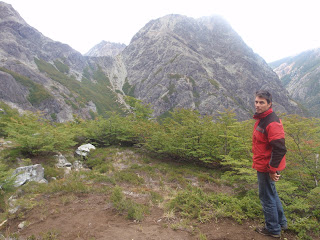

Matias, his hardcore mountain saavyness, and his incredible patience win the triple MVP award of the four refugio trek.

After crashing through trees, scaling rock walls, sliding down canyons, and surveying the landscape to make sure we were still relatively on the “right” path… we joined with the real trail. When I saw the trail markers, I knew we were saved! When the rooftop of the refugio peaked over the rocks, a wave of relief flooded over me. Happiest moment ever!


There were four of us that night. Fede, the refugiero; Sergio, the veterinarian from La Plata; Matias; and myself. We stayed up late drinking boxed wine, eating luxurious pizza, and chatting around the fire burning stove.

Laguna Negra to Lopez

Matias told me a few days later that after our “detour” the day before, he thought that I had had enough adventure and would want to go back to Bariloche from Laguna Negra without continuing on.

Fat chance.

There was no way that I would come this far and not take it to the end.

We got a late start to Lopez. In fact by the time I woke up and sauntered over to the refugio, our buddy Sergio had already taken off.

After our morning mate and breakfast cereal, we set off in search of the last stop on our refugio adventure. Around the laguna and up to the mountain ridge.


Tronador was hiding that day, and yet we were fortunate to see him peaking through a cloud window.


The path took us over large unstable black rocks that rocked gently to keep us paying attention. I was beyond words. We were walking along a mountain ridge. This is as real as it gets, I exclaimed, there is nothing more real than this. The world extended below us. Life doesn’t get much more lifelike.

We descended into a valley and as we crossed said valley, Matias pointed out a mountain in the distance. See that mountain, he asks, I think we have to climb it.


No.

He must be joking. It was a mountain mountain we was referring to. Not a wimpy fake mountain. A real mountain. I couldn’t, wouldn’t, didn’t want to believe him.

But, of course, he was right. I looked up. A mountain of loose stones of various shapes and sizes. The sun was low in the sky. The light was getting the mystical quality of late afternoon. There was not much time to dilly dally. This mountain had to be climbed. And relatively quickly.

When you don’t have any other option, you can push yourself to do the unthinkable. I really didn’t have many options. The path that led to the next refugio passed over this mountain. And I had to climb it.

Up up up. Shaking legs trusting in wobbly rocks. Up up up. I was tempted to look down, but decided against it. Up up up. Until the tippy top was within reach. Up up up.

At the top, I allowed myself to turn around and look down. What a feeling.

It was all downhill after that. When a pink Refugio Lopez came into view, a smile was born. A knowing smile. A smile that only the last refugio on this journey could provoke.


That night we fell asleep to the wild screeches and squawks of a lost condor, a confused fox on steriods or an outraged tourist. We’re not quite sure which.

Lopez to Bariloche

Do you ever have those moments that make you stop to think: “Wow, this is too amazing to be coincidence!”? Some people call them divine intervention, some people call it fate, some people call it luck. We had one of those moments on our way down from Lopez, which for me, was the cherry on the top of the snow covered mountain.


When you’re in the mountains, time takes on a different meaning. Hours and minutes mean very little. Sunlight is everything. Moonlight is everything else

Coming down from the mountain meant that we had to get accustomed to playing by society’s rules once again. Rules governed by the hour and minute hands of the gigantic life clock. When I found out that the bus passed by the trailhead around 12:10pm… and then again at 16:40... It became pretty important to catch that first bus. Unless we wanted to wait for four hours.

Matias had a little less urgency to catch that bus. Afterall, only one of us is from the big city rhythm. By the time we started heading down the mountain, it was 11:50 and it was clear that there was no way that we would make it to the bus. Nonetheless, I started to jog down the mountain. We jumped over roots, dashed around corners, avoided tourists. I knew we were going to miss the bus, but kept the pace up anyway and we sped down the mountain. By the time we reached the main road, the clock struck 12:21pm. My hope frowned.

Matias passed under the wire fence and turned back to help me with my backpack. The little glimmer of hope still residing in me told him to go to the right and check if the bus was still there. As I was ducking under the fence, I heard a shout. And a honk!

By chance, the bus was passing right when we stuck our heads around the corner. If we hadn’t run down the entire trail. If we had said one more word to the people we passed on our way down. If I had passed Matias my backpack under the fence. If we had spent one more minute talking to the refugiera. If the bus hadn‘t been 11 minutes late… we would have missed our ride. But as fate, chance, luck would have it… we made it, sweaty and out of breath and all smiles.

And, with that, I end the story of the four refugios: with a smile, a little bit of luck, and a good story. And, with that, my last goal for Bariloche is accomplished!

Saturday, March 26, 2011

Once upon a time…


A girl with a purple shirt couldn’t buy a motorcycle due to bureaucratical hardships. Her lips formed a pout and her arms crossed themselves at chest level as she pondered her options. Her mind oscillated among the dream worlds of feasibility, possibility, creativity, passion, and imagination. Much like mental window shopping.

The idea of pedaling crossed her mind, but was dismissed along with many other good ideas. If it wasn’t motorcycling, it just was not good enough. It’s mind-blowing what amazing possibilities can be sent packing due to even the smallest doses of stubbornness and closed-mindedness. Consequently many competent results of various brainstorming sessions got thrown in the idea compost.

But when the desire for travel, the itch for adventure, the yearning for change all become too great, options once casted away are reluctantly reconsidered. Maybe the hot-air balloon idea wasn’t TOO bad. Or maybe helicopters aren’t AS difficult to fly as they say. Or maybe I CAN do a long distance bike trip, even though I’ve never really ridden a bike.

And so the idea was conceived. Over the time, it took shape and form; details ironed out and questions satisfactorily answered.

February 28 was my last day as a Canopy instructor. What a fun job! I learned a lot and spent a lot of quality time flying through the trees enjoying the Patagonian summer sun.

The very next day I bought the bike.

And the helmet… Mom…

And that’s how it began. Over the next three weeks I got the bike racks, the saddle bags, the reflector lights, the kickstand, the mirror, the cool gadgets to adjust screws and things, and… my favorite purchase by far… the bike shorts with the butt padding. I love these shorts. A lot.


In fact, my love for my bike shorts far surpasses my love for any other inanimate object. True statement.

But along with all the cool biking toys I get to purchase with my hard-earned Canopy money, comes the training. I have to build up my legs, my lungs, and my spirit to prepare for a trip of this scale.

My goal is to get to Jujuy, northern Argentina. For a beginner biker, that’s quite a trek. Over 3000 kilometers. Have I mentioned that I’m not really a biker? I do alright. I defend myself. But I’d never even considered a long distance bike trip. It was always for real bikers. I most certainly wasn’t a real biker.

But there’s nothing like the smell of a good adventure (and gorgeous Argentine landscapes) to get you to push your own limits. What if I CAN do this? Amazing the limitations that you put on yourself with a closed mind. But I think I’ve mentioned that already in this blogpost…


Over the past three weeks, this trip has been unfolding, developing, and blossoming. And it’s starting to look not only possible, but that it also could end up being enjoyable. How do I know this? Well, I did a mini-trip. A test-trip I call it. And it was good.

Up until the day I left for Villa La Angostura, I had been training a little bit. Maxing out at 40 kilometers per day. Some hills. Some flat. Some traffic. Some deserted winding mountain roads.

From Bariloche to Villa La Angostura there are approximately 85 kilometers. That’s double my daily average. And, yes, I planned to do it all in one day.

I don’t want to go into details by giving a kilometer-by-kilometer commentary, but I made it. In one piece. Needless to say I was an incoherent exhausted mess, but triumphant nonetheless.


What I will mention though is that I may have picked the windiest day in the history of all windy days to do this trip. And, of course, the wind was heading east as it always does, and I was heading west. I understand now why some people find Patagonian wind infuriating. Yes, I did lose my temper. Yes, I did scream and curse. Yes, I lost a lot of energy getting angry at the wind. And, yes, I do understand that there is nothing productive about getting angry at the wind. But I’m relatively new to biking… and I’m starting to realize that the world is a windy place when you’re on a bike.


The last 10-20 kilometers were the longest, toughest, and most challenging ever, but as I rolled into the quaint tourist town of Villa la Angostura, it was suddenly all worth it. Suddenly my legs didn’t hurt as much. Suddenly my goosebumps erupted in jubilation. Suddenly the hours and hours and hours on the bicycle seat didn’t seem so bad. Suddenly wind, the horrible wind, was a distant memory. And in my exhausted excitement, I took a picture.


I was too tired to look for a free, out-of-the-sight-of-the-police spot to pitch my tent, so I forked over some pesos for the rights to a small plot of grass in a campsite. After some of the best mates I’ve ever had, I threw my barely conscious body in my tent and passed out to the sound of Bob Marley coming from the next tent over. It was 9pm.


Around 2am I woke up to the most intense, most excruciating pain. But, in my delirium, when I tried to pinpoint the origin of the pain, I was surprised that it came from almost everywhere. My sunburnt legs stung. My back hurt, in two different places. My lungs burned. My throat ached. My jaw throbbed. My face felt like it was falling off. And my feet were frozen. I realized that my body was in shock. I drank some water. I ate some crackers. But I was in so much pain. Uncontrollable tears streamed down my face. What was going on?

If you push your body to its physical and mental limits, it will react. Especially if you then proceed to sleep in sub-zero temperatures in a tent. Especially if you haven’t had enough water or food. So push your body, but then take care of it. Or push it comfortably. Or push it hard, but be willing to deal with the side-effects. Hmmm… There may be some good lessons to be learned here.

That night and the next morning I seriously considered putting the bike on a bus and return to Bariloche. The idea of biking back was unfathomable. I had done my 90 kilometers. I learned some good lessons. I could still consider the trip a success. Couldn’t I?

The next morning, after a devouring a generous portion of hot oatmeal, I cycled into town and went to my favorite bakery. Arte y Manteca (Art and Butter) was recommended to David and me on a border-run trip that we did in June. Finger-licking good pastries. I’ve always been meaning to go back. So I did and I picked out some spirit-lifting, bad-mood-erasing, dulce-de-leche-filled goodies. And I decided to attempt the bike trip back home.

The day was perfect. No clouds. Blue blue blue skies. And, best of all, no wind!!

It was on this day, that I discovered the pleasure of biking.

Biking is freedom. There is nothing between you and the trip. You control the trip. You ARE the trip. You feel the breezes. You coast down the hills. You race the clouds and competitive little yellow-jackets. You stop for water. You stop for the subsequent bathroom breaks. You chose to eat your lunch at the most picturesque beaches and then take an after-lunch nap on the rocky shore. You wave to motorcycle dudes and dudettes. You stick out your tongue at cars and wonder where the rush is. You freak out a little each time a truck or a double-decker bus pass you. It’s adrenaline and relaxation. It’s the meeting point of being exposed and being in control. And you are the protagonist.


Biking is not about arriving at the destination. Biking is about the journey to get to a destination.

And, to state the obvious if I may, biking is slow. Very slow. It’s not for people who are in a hurry. It’s not for those with schedules and deadlines. It’s not about rush rush rush. It’s about the road. It’s about the moment. It’s about patience, enjoyment, and sloooooooooowing down a little bit.


I‘m still new to the biking lifestyle, but I’m picking up a few things. Like how sometimes you stop and have amazing conversation with super interesting bikers. Imagine, you’re going down the road and, along comes another biker. You’re going slow and so you have time to cross the road and come bike-to-bike with the other individual. You’re in no hurry. It’s a beautiful day. You stop and talk. They most likely have some amazing stories to tell. And then you each go your own way. It’s a great feeling to get encouraging waves, smiles, and fist-pumps from almost everyone you meet along the way. You can stop and try to help the exasperated Brazilian couple with the broken down car. It’s the small-town kind of traveling.

At the end of the second day of pedaling, I arrived in Bariloche exhausted, sunburnt, sweaty, and in disbelief that I had actually pulled off the seemingly impossible trip. Sometimes when you set the expectations high, you can surprise yourself when you achieve the unthinkable. So let this moment be the green light for you to do your unimaginable. Try something you’ve never done. Go above and beyond. Go for it!

Wednesday, March 16, 2011

i bought the bike

yes. the bike.

the bike that will be my only travel companion on the long desolate roads leading north.

the bike that will be my best friend, worst enemy, and everything in between.

the bike that will test my strength, mental and physical.

the bike that will accompany me on my first ever long distance bike trip.

i have yet to name the bike, but it will have a name.

i have yet to take a picture of the bike, but as soon as i do, i will post it.

now... alisa, stop blogging and start training! :)

Wednesday, March 2, 2011

a word on social activism

When a young woman’s thoughts wander into the highest strata alturism clouds and busy neurons, for this or that selfish or benign motive, entertain the idea of being a pivotal figure in global social change, she must think twice (three, four, fifteen, seventhousandsixhundredandfour times) about what that change might look like, how to implement it, and the heavy burden of responsibility in calculating its consequences.

Where does this motivation of instigating large-scale social change originate? Why do we feel the need to help others (a need that is evolutionarily unfavorable)? Is it because we honestly want to help people we know nothing about because of the goodness in our hearts? Is it because we have felt pain and struggle at one point in time and we want to prevent it from occurring to others? Is it because we have some hole in our lives and are desperate to fill it with something meaningful? Is it because we are escaping some bigger problem in our own lives by focusing on the misfortune of others?

The idea of making big social changes in the world (saving the world, as it is sometimes called) is a very upper middle class American idea. We dream of eradicating child labor, feeding the world’s poor, halting wars, educating school aged children, building houses-hospitals-watertreatmentcenters. These are all romantic ideas that many liberal arts college graduates have wet dreams about. I can safely assume that a good fraction of my readers are salivating at the mere mention of such examples of do-gooding. We desire that self-assured heart-warming sensation of knowing that we have made a positive difference in a person’s life. We congratulate ourselves, we feed our egos, we feel damn good about ourselves… and then return to normal life… forgetting perhaps that we have treated a single symptom and turned a blind eye to a much larger, much more evasive cause of the illness.

I went to a college whose motto was: Think one person can change the world? We do.

But with time (and subsequent travels and experiences) I am changing my view on what that change should look like. In high school I thought that protests, clever posters, and rhythmic chanting were the key to change. In college I thought individualized education, motivating, inspiring people was the key. Now I have a different outlook.

For example, I strongly dislike the Peace Corps, and other such volunteer-for-a-better-world organizations. I dislike the idea of going into other communities with the intention of helping them. I dislike signing petitions on issues I don't know anything about. I dislike supporting wars in other countries. I dislike protests on issues that aren't my own. Who am I to impose my views on others? Especially when the issue is much more complex and multifaceted than I can possibly imagine. It is never black/white, right/wrong, good/bad. It's never simple. How can I possibly know what's right?

And these organizations, international movements, petitions are like a semi-permeable wall between volunteers-concerned citizens and the very people being affected by these altruistic acts of kindness. Foreigners descend on a poor helpless community stricken with some unfortunate circumstance. A decision is made to help this community. Forget communication and working alongside the recipients of this noble act. Volunteers chests-puffed with good intention flood the surprised community. Within months the project is finished and the community is left deserted, inhabitants wonder what the hell just happened and why they now have this ridiculous monstrosity to deal with.

I dislike the volunteer-based-social-change-organizations just like I dislike tourism. It’s impersonal. It’s very self-absorbed. It’s ironically egocentric. It has little or no regard for the actual people or culture of the society. It’s a wham-bam-thank-you-ma’am approach to a bigger, more valuable, realer action.

And just like the social change movement is a safer diluted form of international altruism, tourism is the safer diluted form of traveling. It’s comfort that you pay for. It’s a boundary placed between you and the local people, society, customs, culture. It’s a jacket placed on a puddle so you don’t get your feet wet. It’s training wheels on a bicycle. It’s a security blanket. It’s someone holding your hand. It’s safe, harmless, cuddly, and boring.

And another thing I've learned is that change can’t be forced upon people. It can’t be imposed because it will only be artificial. Change is not only on the surface; it is internal. Change can only be inspired.

So I think instead of taking the “I know what’s good for you, so let ME teach you a few things” approach to international altruism… there is a realer option. You could go to another country with the idea that perhaps they have something to teach YOU. Your objective would be to learn, absorb, live and observe. Not to impose, teach, turn your nose up, and hide behind a Lonely Planet in comfy English-speaking hostels. You could communicate in the colorful street language. You could learn a few local recipes. You could meet the people who live there. You could listen to their stories. You could dance to their music. You could grow like you’ve never grown before. You could be humbled by the beauty of local culture.

And I’ve learned that the best social change is nothing tangible. Social change is taught through experiences. From every trip I take a lesson learned. From every person I take a world of love. I grow as a person. I put aside my ego. I put aside my pride. I am a visitor. I am the outsider. I have everything to learn. I have my own experiences to teach. And we trade, barter, exchange stories, laughs, experiences. If I evaluate the tangible and the intangible things I’ve received or left behind, the intangibles are worth infinitely more than the tangibles.

So I think I finally truly understand what was meant by the quote: be the change you want to see in the world. Let yourself be changed. Absorb the beauty of every culture, story, song, smile, moment. Change with each passing experience. And then live. Truly live. Live ethically, live passionately, live based on what you’ve learned, live the example of what you believe, live well, live live live. And you will change people passively with your kind words, passion, view points, conversation, lyrics, and melody. You will influence the change you believe in. That is the only true way to realize social change.

Wednesday, February 16, 2011

the brightest rain drop

Another summer season is slowing down. I’ve mentioned the concept of seasonal tourist economy and its effects on job availability and salaries, haven’t I? Long work hours. Lots of customer service. Lots of mate rounds to keep sleepy eyes open and wilted smiles fresh.

We all started the season with eager faces and attitudes, ready and willing to put our all into our jobs. Everything was new and fun. And with my job even more so. I absolutely loved it. But now as we’re approaching the two month tick on the calendar, I’m starting to observe certain changes in moods and attitudes.

It’s interesting to see how people deal with boredom, stress and unhappiness. When routine takes over and life loses its glamour. When you allow yourself to be consumed with thoughts of past and future. Or of other places. People. And you lose the lust of the moment.

Passion. Love. Enjoyment of the little gems of everyday life.

Like climbing a tree and entering into a wonderland of glossy, succulent, red orbs hanging in clusters less than an arm’s reach from your mouth. You sit on a sturdy branch, make yourself comfortable, and then begin devouring by the handful. The day is a flawless blue; not even a whisper of a cloud between the mountain peaks. Your neighbors chirp as if celebrating the mere existence of life, as they too feast on ripe berries, leaving nothing more than the naked pit hanging from the slender stem. You can’t help smiling at the beauty of it all and a small happy chill runs up your spine. You feel at ease. You feel perfection. You feel love.

Or

Like riding a bike through a calm Patagonian night. A beach bike with high handlebars and a comfy seat, so you sit straight up. All that is missing is the basket in front with a few daisies peaking out. But it is 3 o’clock in the morning, and all good little daisies are home asleep anyway. It’s odd, you think, to see this normally traffic encrusted road completely void of rumbling motors, eye scorching exhaust fumes, abrasive honking, and wildly colorful insults. In fact the only sounds are quiet mechanical workings of the bike, wind in your hair, and the occasional territorial dog excited by your apparent invasion of private property. A quick glance up to the starry sky is enough to provoke a gasp and have you clinging to the bike for stability. The night is warm, for Bariloche, and the sky is full of uninterrupted starlight. The rhythmic pedaling motion sends your body into autopilot and your mind into a passive overdrive. You’re here, but elsewhere. Concentrated, but relaxed. It is yet another perfect moment. Like every moment. But you are aware of its beauty and magic. And that’s the difference.

Sometimes it’s all about living the moment. Loving each second and being completely immersed in whatever you may be doing. Whatever it is, it can be enjoyed. Whether it’s waiting for the bus, lounging on the beach, sitting in the tent listening to the rain coming down, flying through the trees yelling louder and louder each time, cooking pasta, cudding with mate and a loved one watching a bad movie… whatever it is, it is to be lived and loved. So if you find yourself losing your smile or grumbling about rainstorms, price inflation, traffic jams, or burnt pizza remember that attitude is contagious. The biggest change we can make is from within. Let’s live positively. Focusing not on the darkest cloud, but rather on the brightest rain drop.

Wednesday, February 9, 2011

a moment in time and thought

Sitting on the shore of lake Nahuel Huapi. Passing a cold beer between two pairs of hands. Subtle waves colliding with the polished beached rocks. Countless stars burning indifferently to two individuals millions of light years away. The blossoming conversation was not the only communication between the two. Fingers tossed rocks into the icy waters unconsciously keeping the beat to a ongoing love story.

The constant struggle to find balance, meaning, love, truth, wisdom, and peace.

The conversation oscillated circling around hard-to-reach topics. Growing, changing, budding, diminishing. The girl found herself caught in the constant pull towards balance. Fighting to find the equilibrium between comfort and growth. On one hand a desire to explore, to dive into the next adventure head first at a moment’s notice, to live and love, to sing a different melody, to feel security in the insecure. On the other a newfound sense of comfort and security. A sensation only accomplished by relative stability, longevity, and personal connections in one geographical place. How can one satisfy both opposing desires simultaneously?

Cognitive dissonance. A disconnect and apparent struggle for power between mind and body. Much like bungee jumping, thought the girl. Your mind has evaluated the risks involved and is determined to jump. The consciousness is thrilled with the flood of adrenaline to the brain. The love of adventure asks the age-old question: why not? But your body does not agree. Your eyes see the immeasurable distance to fall. Your ears hear the wind blowing far below your shaking feet. Your shoes do not move. The body deems it highly undesirable to hurl itself into a free fall. There exists a moment of pause. Two equal and opposite forces pulling an individual. The result: stalling.

The curiosity begins with the origin and central hub of all this struggle. The brain. Simultaneously the brain is both analyzing the situation from a rational standpoint and from a physical stand point. I present our two protagonists: the conscious and the unconscious. Consciously we have decided to (and paid even..) to have the experience of throwing ourselves from a high place, falling down to the ground, only to be jolted back up on an elastic rope. We have calculated risks, knowledge of prior experiences, and even (perhaps) the pressure of our peers. At the end of these processes, we have concluded that we would like to partake in this activity for the thrill of the adrenaline.

Objection. The body holds up a red flag. Unbeknownst to us it has been doing its own calculations. Centuries of evolution have favored instincts based on survival. Throwing oneself off of great heights is not favorable. The body wants nothing to do with this madness. These processes are also occurring and developing in the brain.

The brain is home to many many diverse processes. And now I see that many are contradictory. This struggle leads to a moment (a split second or even a few minutes, hours, weeks, years) of inactivity. What to do?

Can this observation be applied to other facets of life? For example the struggle of our female character.

She finds herself in a situation. Wanting a change. Wanting to plan for the unpredictable future. Wanting some stability and security, but spontaneity and excitement. She is in limbo. She is in the period of calm and uncertainty before the electrical storm. She wants a million things. She desires conflicting paths. She needs a push.

In less than two months, she will leave. She has convinced herself that a two month deadline is a necessary evil. Whether or not she will leave alone. No matter where she decides to set her compass. If she is ready or not. She will leave. And that causes a thunder storm of emotions.

Next chapter here we come. Uncertainty is inevitable.

Monday, February 7, 2011

i have a new job

Monday, November 29, 2010

How to buy a motorcycle in Argentina if you’re not Argentine...

My advice… Don’t. Consider the option of going home to your country of origin, buying the motorcycle there, getting all the paper work sorted out, and shipping the bike down here. But if you’re stubborn like I am, here’s a run down of the logistical maneuvering that I performed in my epic motorcycle search.

Choosing the Bike:

You may know a little about motorcycles. You may already know how to ride. You may know a touch about motorcycle mechanics. You may even know which bike you want to buy. If you do, you’re leagues ahead of me.

What I learned is that when choosing the bike, the criteria is completely dependent on YOU and your needs. No one can really tell you what motorcycle you should buy… Different styles, brands, models, accessories exist because people will want to use their motorcycle for different purposes. If planning to use the motorcycle within a city, perhaps a scooter or a 125cc is sufficient. If planning a long distance trip, you’ll need a comfortable, sturdy bike with a relatively powerful engine. If planning on jumping over dirt paths and performing tricks, a lightweight easily maneuverable bike is your choice. Price will depend on engine size and brand. Japanese brands will cost more than Chinese brands, but will be better quality and much easier to find spare parts. En fin, there are many things to consider…

Wandering through the motorcycle shops in Neuquen, I was confronted with an overwhelming number motorcycle options and opinions. Everyone had something contradictory to say. None of their opinions was wrong, but that’s just the thing, they were opinions. And especially here in Argentina, everyone has an opinion.

It took a while, but I finally decided on a motorcycle. A chopper (comfortable for a long trip, low riding for stability, and definitely badass looking), 250cc (a big enough motor to defend itself on long open roads, but small and manageable enough for a beginner motoquera), Mondial (not a pricey high-end Japanese bike, but a decent brand. Mixed reviews tho, of which I’m super weary. Hard to find spare parts, especially up north. But if I arm myself with a little motorcycle maintenance knowledge… I can perhaps prevent all but the most unpredictable problems.) So, after weeks maybe months of searching, I had found it: my motorcycle. The Mondial HD 254.

The Logistics:

My first mistake was to go about everything as legally as possible… And expect it to be easy.

When you buy the motorcycle you have to go through the process of patentamiento. Which I’m not sure I totally understand. But once you pay your money for the bike, it’s not technically yours… Yet. You have to take the 01 form along with the receipt of the motorcycle, the certificado de fabricacion o importacion, and the verificacion policial to a non-descript building on Ruiz Moreno Street.

There, you will take a number and, once you are attended to, they will tell you that you need a CDI, a CUIL for foreigners. Basically like a social security number. Ok. They tell you go to ANSES on J. O'Connor, half a block from the Hospital. You wait in line. There, you are told to go to AFIP, at V.O’Connor (not to be confused with the first O'Connor) and Onelli, because at ANSES they only deal with CUIL and CUIT. Ok. Down to AFIP. You need a photocopy of your passport and to fill out a F. 663 form.

If you chat it up with the guy at the desk and wow him with your travel stories, you can get it extradited. Your CDI will be ready in a day and a half. Free of charge.

Great. You go back to the non-descript building on Ruiz Moreno. I still have no idea what this office is. But I think it’s the place to change a vehicle title among other things. Oh no. They tell you this time, that even if the vehicle is in your name, you can’t take it across the border. You can only use it within Argentina. But… go talk to the Aduana, above AFIP on O’Connor, and see what they say.

Back to AFIP. Third floor to the Aduana. There, a hard-faced woman who listens to your questions will shove a bunch of “no’s” down your ear until you almost break down in tears. Then, she’ll soften up a bit and pull some strings to help you out. Her advice: get your DNI.

Next stop, the Oficina de Migraciones. The super unfriendly guy gives you two options for acquiring your DNI: get someone to hire you (he didn’t have an answer when I told him that most businesses will ask for you to have a DNI in order to offer you work) or marry an Argentine.

Chan. At this point, you go back home depressed, seriously consider getting married for the residency papers, and eat half a dozen empanadas.

I digress into the actual process of BUYING the motorcycle. After searching the internet, phoning numerous places, and walking around town… My motorcycle would cost me AR$13.000 in Bariloche. The same bike would cost AR$10.000 in Buenos Aires. Three thousand pesos is quite a difference. So I could buy the bike in Buenos Aires and ship it out to Bariloche. After calling a few places, the best deal was AR$500 for transporting the bike.

So, it was settled, I’d buy the bike from an agency in Buenos Aires and then ship it here to be patentado. If I put it on my credit card, I’d be charged various fees and I would surely max out my credit limit. So, I’d have to deposit the monetary quantity into their account. That would mean that I’d probably have to open up my own bank account in Bariloche, which now having my CDI, I could do. But talking to some ex-pat friends, the fees and complications in the Argentine banking system is something I don’t really want to touch with a 2-meter-compost-stirring stick. And then I’d have to figure out how much my bank in the States would charge to transfer money. If I went through all that quilombo, then I’d have to be sure that the motorcycle agency in Buenos Aires is reliable… because, well, if I transfer all that money… I’d have to be sure that they’d send me the motorcycle. Sigh.

Let’s now move on to the DRIVERS LICENSE! For this, you have to go to another practically un-marked building, this one is past the train tracks, but before the bus terminal, down a gravel road. No line this time! Friendly guy at the desk explains that to get the registro de conducir you need: 1. Libre de deuda of your vehicle and of yourself (which you get on the first floor of the bus terminal and is valid for 5 days), 2. Your DNI (oh crap, not this again… but it’s ok, says the guy, all you need is a passport and a certificado de domicilio, which you get at the comisaria at Km 5), 3. Two photos (done!), 4. Three medical exams (medico clinico, medico oftamologico, and medico otorrinolaringologo… good luck pronouncing that one!), 5. Pass a written test, 6. Pass the driving test, 7. Pay AR$45.

Oh, but wait. Because you are in Argentina on a tourist visa, the drivers license is only valid for the period of three months. Every three months you have to renew it. He looks at you and asks: Why don’t you just get your DNI and residency…?

Ahhhhhhhhhhhhhhhhhhhhhhhhhhhhhhhhhhhh!

All of this is best summed up by Randy: “the Argentine government will leave you alone for the most part… unless you want something from it.”

So after this excruciatingly frustrating ordeal, I have a few options.

1. Buy the motorcycle in Argentina anyway. I’ve gotten this far. The only problem would be that I wouldn’t be able to leave the country. And for those who have had to do the 3-month boarder run ritual, part of the purpose of buying a motorcycle would make that chore a little easier, cheaper, and more fun. I would also not be able to cross over to Chile, Brazil, Paraguay, or Uruguay. Un bajon.

2. I could go to Chile and buy the motorcycle there. The motorcycle itself will be cheaper. But I’m unfamiliar with the Chilean ways. I’m guessing they will have their own bureaucracy, although perhaps not as chaotic. They might treat me differently because of my psudo-Argentine accent.

Also, another thing to consider is that with a Chilean motorcycle I might have a hard time finding spare parts in Argentina (as was the case with some Austrailian friends whose car is still in Comodoro Rivadavia after almost a year waiting for a spare part).

Also, I think the Chilean government obliges me to return the motorcycle to Chile every three months, which is okay because I need to renew my visa anyway, but what happens when I head towards Brazil or Uruguay?

3. Go back to the States. The motorcycle might be cheaper there. I could get the drivers license taken care of without too much hassle. I wouldn’t get the “you’re not from here” stares and comments, which are starting to wear me down.

But then I’d have to figure out how to get it back down here without paying absurd import taxes… Or perhaps pick another country, in which case I’d have to say goodbye to Argentina. And I’m not sure I’m ready to do that yet.

Sigh.

Thursday, November 18, 2010

Neuquén... and the search for the perfect motorcycle

After days of postponing our trip due to wind, rain, hangovers, and a dead motorcycle battery… Matias and I finally set off for Neuquén. But separately. One on motorcycle; one hitchhiking. Who would arrive first? On your mark; get set; GO!

I gave my compost one last loving stir, shouldered my trusty yellow backpack and set my sights northward. I took the #20 to the very end of the line and then walked two kilometers to the speedbumps passed the Aspro, the last gas station in Bariloche, my preferred hitchhiking point for all destinations east, north and west.

Yellow skirt flapped in the wind. Bags at my feet. Thumb outstretched. Smile. Mountains, lake, blue sky… all waiting in eager patience. A car pulls over.

Three vacationing portenios make room for me and my bag in their Piedra del Aguila- bound car. And we’re off.

I cast a farewell glance over my shoulder as my beloved snow-capped Andes grower smaller and smaller behind us. We pass Villa Llanquin. Valle Encantado. Confluencia. Mate circulates counterclockwise around the car. Music blasting. The road twists and turns as it follows the winding river away from the mountains and into the arid pampas. I pulled out my crochet hook and rainbow yarn as conversation passed around and through me. The fernet was uncapped and before I knew it we were pulling into Piedra del Aguila.

The kind of small dusty town where everyone knows everyone and, if they don‘t know you, they‘ll greet you anyway. The sun pelted pedestrians with powerful rays and I declined the invitation to head down to the lake. I still had a journey ahead of me. I was only half way to Neuquen.

And so was Matias. It just so happened that we arrived to PdA at roughly the same time. Tie. We met in the park, picnicked, and played on the swings made of recycled metal scraps. When it was time, we said goodbye and each one headed back on the open road.


Not many cars pass through Piedra del Aguila (which translates to ‘Eagle Stone’). I took the opportunity to check out the low cement houses, kids playing soccer, and the awesome looking rock formations surrounding the town. The sun was fierce.

After a local police officer kindly offered hitchhiking advice, I got a comfortable ride with a very business business man. I opened the car door to a button-down-shirt wearing, blackberry-with-earpiece toting, espresso-in-mini-Styrofoam-cup drinking important person. I felt like the 200km ride to Neuquén was taken straight out of a Hollywood feature film. Big important business man meets adventure travel permaculture girl. And they travel in a confined space for two hours. Lights. Camera. Action.

We zipped past apple orchards; heavy metal plants supplying the nation’s nuclear research; small towns by the names of Picun Leufu, Chocon, Arroyito, Senillosa, and Plottier; lots of flat desert; Matias and his motorcycle; and a variety of conversation topics.

Arriving in a new city is always disorienting at first. Especially when your only reference is the tongue-twisting street name: Olascoaga! Nonetheless, after minimal eyes-pealed inspection of all street signs, I plopped my bag on the sidewalk and waited. Juanjo and his RED truck showed up and whisked me away.

I feel that Juanjo needs a introduction. But how can I possibly do him justice in a paragraph??


Imagine, if you will, a six-foot-something, long-haired, walking contradiction. On the surface he seems flakey, flighty, irresponsible, chauvinistic, and completely out of control. But after you stop rolling your eyes at him and his chaotic incomprehensible lifestyle, you’ll perhaps see the other side. The business-savvy, liberated, confident, jack-of-ALL-trades, sweet-talking side. Just because he is almost 40 and doesn’t have a permanent job or permanent house (I don’t believe the word ‘permanent’ even exists in his dictionary), doesn’t mean that he isn’t providing himself with a rich and incredibly interesting life. His stability is in instability. He goes about everything with every ounce of his energy and passion. He has had every conceivable kind of job. And can chamuyar his way out of any situation. He can basically get anything he wants. In other words… a character.

As we sat down to tea, a text message from Matias informed us of a motorcycle malfunction. Red truck to the rescue! We find Matias stranded on the side of the road past the airport and rig up some makeshift towing contraption out of bent wire. Everything in Argentina can be fixed with wire and ‘la gotita’ superglue. True statement.

After briefly story swapping, Juanjo announces the plans for the night: a friend is performing at a bar in Villa Regina. Matias, Juanjo, musician friend, and I cram into the front cabin of the red truck. With the music equipment in the back we bounce one, two, three, four, five towns over. The show is awesome and filled my head with get-rich-quick schemes. We were in bed by 7am.

Needlesstosay, we were out of commission on Saturday morning. Which meant that, because stores are closed on Saturday afternoon and all-day Sunday, motorcycle shopping would have to wait until Monday morning.

How we ended up spending two weeks in Neuquen is beyond my explanation. Juanjo generously allowed us to take over his apartment for 5 days. We cooked, slack lined, looked at bikes, ate ahumados and dulce de leche, and baked in the Neuquenian sun.


When we felt like we were pushing the limit on overstaying our welcome, we turned to couch surfing.

I hadn’t couch surfed since my Ushuaia-trip, but after I browsed some profiles and sent out a few couch surf request messages, my phone started ringing. Daniel called first.

Daniel, Lucia, their children: Pedro (7) and Catalina (4), and their dog: Zeta welcomed us into their home. We stayed for 5 nights, playing pirates searching for lost treasure, watching Iron Man 2, staying up until 3am chatting over wine and Cordobes accents, and keeping the kids up past their bedtimes. We were too busy having fun to actually take the motorcycle-search seriously.

Next, we stayed with Chana (and Jack the dog). Que personaje! What I love about this girl is her energy, her passion, her strength,, her honesty, her no-nonsense attitude, her drive to learnlearnlearn and (perhaps more than everything else) her uncontrollably contagious laugh. She hand-makes carpets, paints, dances, crochets. She’s teaching herself Italian, Turkish and Arabic. And she gave us her room for 3 days.

During those three days I decided what motorcycle I wanted to buy, we cut off Matias’s dreadlocks, we slack lined, I accompanied Matias to the public hospital (another blogpost will have to be dedicated to my opinion the public health system), I learned to navigate Neuquén’s public transportation system, we talked, we sang, we laughed, and we ate.


On the last day, we shuttled our stuff back to Juanjo’s centrally located apartment. Went to the movie theater. Said goodbye to new CS friends. And prepared for our departure.

The return trip to Bariloche was executed in 5 cars. Walked a few kilometers under the hot Neuquén sun with my heavy backpacks, small talking with a random guy-on-bike. Car to Plottier. Car to cruce in the middle of nowhere. Car to Chocón. Car to Piedra del Aguila. Small truck to Bariloche’s bus station. City bus home. HOME!

There’s nothing like being home after a journey.

And although I’m frustrated that I didn’t accomplish my original goal of buying and learning to ride a motorcycle, I had a great time. I learned a lot about different types and brands of motorcycles. I met some awesome new people and got to hang out with old friends. I got to explore a new city. And, honestly, what frustrated me more than the Neuquen trip was yet to come in Bariloche when I dived headfirst into the bureaucracy of what it means to own a motorcycle as a non-official-resident.