 I love it when a river cuts through a valley. And when we’re riding the winding path high up on the mountainside, we can look down at the forcefulness with which the river flows, slicing through the countryside. I love long bus rides so I can stare, wide-eyed, out into the beauty of nature as it glides by the window.I don’t love it when people on the bus momentarily open their windows to toss trash out. What a beautiful country with rolling hills and views that can see forever, but look closer and it’s completely not taken care of. The countryside is the people’s trashcan, littered with plastic bags, bottles and everything else. How unfortunate.We break our fasts on Monday, September 15 in Baños with cold leftover soup from the night before. It doesn’t sit well with us, but it gives us enough energy to pack up our belongings and head out to the bus station. We pass all the familiar sights. I can’t believe we’ve spent so much time here, but a place like this sucks you in.At the bus station we buy our tickets to Riobamba on the 11am bus. As we’re waiting, we run into some friends from the night before. We pass the time joking around and plotting tourists-strike-back schemes.On the bus, I was exhausted for no apparent reason and slept (mouth hanging wide open) the whole way. In Riobamba we walked the few blocks to the Terminal Terrestre where we met Stephan, a friendly German tourist, and bought our tickets to Cuenca.The view was amazing. Once I got myself into a comfortable position with my gigantic bag, I could actually enjoy the ride. Baños and Riobamba had been cloudy that morning, but once we climbed above the clouds, the sun was brilliant. The nearby mountains melted into mist and everything was surrounded in a surreal haze. I nudged Nate and we exchanged wow’s and lookatthat’s!We passed in and out of pueblos. We picked up people on the side of the road and dropped others off at certain driveways. Sometimes there were children balanced in the aisle with noisy lollipops. Sometimes there were indigenous women in thick stockings, black skirts, and black hats and wrapped in colorful shawls.
  Cuenca couldn’t come fast enough. We counted down the minutes, but we were still not there! Finally we arrived at the terminal around 7pm. I don’t like arriving to a new city at night. In the taxi, the driver and I chatted it up while Nate and Stephan exchanged stories.
Hostal El Monasterio was a little bit more expensive than we expected, but it was clean with a private bathroom and a communal kitchen.  And it had a spectacular view of Mercado San Francisco and the surrounding iglesias.
Everything was lit up for stellar nighttime viewing.After setting our stuff down, we set out in search of ingredients for dinner. Very few stores were open. We got some rice and tuna from a very nice shopowner. We got some bread. And with our limited ingredients we made a tasty soup. The kitchen was supplied with cooking implements, but we quickly found out that we were not alone. Roaches came out of every crevice and shuttled themselves into view. Nate was armed with his roach-massacring spoon and protected me while I stirred the coveted stew. When it was ready, much to the chagrin of the roaches, we stole away to our room to eat our meal in peace. We popped in a movie I had picked up the day before. We had never heard of it before.Even though I had slept all through the bus rides, I had no trouble falling asleep that night. I woke up before the alarm on Tuesday, September 16. The prospect of free coffee propelled me out of bed. The shower was perhaps the best one I’ve had since New York! We went to the market in search of breakfast ingredients. The market was a wonderful cacophony of colors! We walked up and down the aisles past vendors with fresh produce. I got apples, bananas, and yogurt for my granola.
 We also got a white fruit with black seeds and tough green skin. Nate thought it tasted starchy. I thought it tasted like mango, but different.
We desayunamos overlooking the Mercado San Francisco. We decided to give Cuenca a walkaround. Our feet led us down the cobble stone streets. Izquierda, derecho, derecha. Those were our options. I directed us towards some Inca ruins. We climbed a hill that produced a decent view, but never found those ruins.
 Lunch was leftover soup, which was pretty good the second time around. I looked up the mysterious Inca ruins on my LP map and realized that I had misinterpreted it! We had gone walking in the completely opposite direction! Go figure.
It was raincoat off- and on- weather! I rolled up my pants for the finicky Cuenca puddles.  We passed trendy shops, tiny restaurants boasting almuerzos, churches, supposed New York Pizza, lots of banks, a few parques, standstill traffic, pirated DVD shops and a few security guards with machine guns. But no café with WIFI. We spent hours searching for one, just one, but to no avail. Let this serve as an explanation for why you are receiving so many blog posts so late!
 Dinner was undercooked and underseasoned beans (we were hungry and impatient!), rice, veggies and fresh bread. We struck up a conversation with travelers in the kitchen. I was wiped out for no good reason at all, so I fell easily asleep.
Next stop: LOJA!
 Baños. Yes, the word itself means bathroom, but that should not reflect on the city. Quite the contrary. Baños is a very nice little tourist town, the kind where there’s English words on every sign, American style breakfasts, and hundreds of vendors all selling the same thing,
  whether its guided volcano and waterfall tours, melcocho (the local jawbreaking taffy), or local artisan crafts. It’s very comfortable and offers familiarity to the tourist. It’s the kind of town I usually love to hate. But this time it’s different. After having Nate’s bag slashed into, spending a night in lamentable Latacunga, and being chased by killer canines, we are ready for some comfort. As we walked down the narrow streets from the bus station into the city itself, we noticed the abundant hostels everywhere. There was one every few meters with colorful signs boasting private bathrooms and cable TV. Next to every hostel was a café advertising pancakes and milkshakes. Nate’s eyes widened; he could get used to a place like this!
 We made our way to Hostel Plantas y Blanco where we got a private room with a view of a plant-filled courtyard. Dinner time! Two days ago after we had climbed up to Laguna Quilotoa, Nate had mentioned how good it would be to eat a gigantic pizza. Well, we were in the right place to get pizza. After surveying our options we head to one restaurant run by a friendly woman where we drink wine and play cards by candle light while our pizza is prepared.
 When it finally arrives, we scarf it down. It’s delicious and pastry-like. I’m full and content, but Nate is still hungry. We try another pizza place, Nate orders a large pie and finishes it by himself. Meanwhile I eat a kid’s size pizza and we struggle through another medio litro de vino. Finally we’re both full and wander the streets giggling on our winebuzz. The next day we allowed ourselves to sleep in. Which meant getting up 9am. We found a colorful café on the side of a tranquil park where we stopped in for a pancake and fresh fruit breakfast. The clearly non-native owner was friendly and the coffee was the best I have had since New York.
 Revitalized we took to the streets. We walked up and down the little streets getting a feel for this city. Don’t know what happened to the hours between breakfast and lunch, but before we knew it we were
  sitting elbow-to-elbow with indigenous families on plastic stools picking chicken meat off the bone in the bustling market. The second plate of our almuerzo was a fried egg, rice, sausage, beats, and salad. We shared a fresh raspberry juice. The whole thing put us back $1.75 apiece. I love the ambiance of the market. People rushing around. Vendors roping you in with persuasive promises. It’s not the cleanest place in the world, especially by American standards, and it gets repetitive after a while, but it scores big points with food quantity and well-roundedness. Plus, the food stall is inside the market, which means that the ingredients are fresh and that you are supporting one local business that supports another. It’s definitely my meal of choice.
  Baños is cradled in a valley surrounded on all sides by towering green mountains. What a beautiful backyard view! We set out for the supposed great hiking through the hills. The paths wind through the trees thick with foliage. We hear strange jungle sounds through the greenery. A horse pokes its head out at Nate. The path heads up and offers up spectacular views.
  Soon we are looking over the whole city and we’re not even to the top yet. Up and up we climb, past a panting family. Nate is cruising and I’m struggling to keep his pace. We climb to the Buenavista cross where we catch our breaths. The view is wonderful and if it wasn’t so cloudy we’d be able to see the volcano. The sun is settling opposite the valley and we decide to head down. But on our way down we see another path promising a Mirador. It’s only 300m, let’s go for it! The path is more vertical, thinner, and covered in thick vegetation. Our jackets come off and our breaths search for more air. We walk and walk. We pass what must be 300m and keep going. By the time we reach something, the sun is on its way down. We snap a few photos and begin our descent. My eyesight is not good at distinguishing roots and rocks at low light, so I take it easy. But we want to make it down before it gets seriously dark. By the time we reach the city, the sun has disappeared and we plan what we’d do in case of a confrontation. But none comes, it’s Baños afterall. We stop in a bakery for some sandwiches and cake! The friendly shop owner obliges even though his kitchen was long since closed for the night. I want to take advantage of the Friday night fun, but Nate seems less than enthused. So we walk around getting asked if we want to go on a volcano-watching chivas.
  Baños is named after its natural thermal baths. There are pools with different temperature water where people sit and soak. The next, Saturday, morning we get up super early to beat the crowds. The alarm goes off at 5:30am. We stumble through the early morning light and we arrive before 6:30am. The complex sits at the base of a waterfall and was already packed by sunrise!
  Families were relaxing and wallowing in the natural medicinal properties of the water. We dipped our feet in one pool. Brrrr… It was freezing. We opted for the “just right” pool next. After a while of just bobbing along, we tried the last pool. As I walked in, my face switched to the shocked position. It was so hot! I didn’t understand how some of the people were able to stay in for so long! One very old man grinned at us and told us that the hot water was good for circulation, while doing arm pumps. We giggled. We pool-hopped. Warm-hot-warm-hot… Until it was time to go. We felt relaxed. It was well worth the $1.60. We walked the few blocks to the hotel in time for breakfast on the roof! I run into a traveler I had met in Popayán, Colombia and she and another girl joined our table.
 Nate had a massive pancake breakfast.While Nate took a brief siesta, I went walking. The main iglesia of Nuestra Señora de Agua Santa was packed for mass, so I went upstairs to the museum instead. What an eclectic mix of random stuff!
  From offerings to the patron saint to taxidermied animals to traditional dresses to a two nosed pig’s head in a jar. I picked Nate up at the hotel and we walked around for lunch. Nate ate at Casa Hood while I took my chances at the market. He wasn’t feeling well, that was clear, so we took it easy on his stomach. We read about the how Nuestra Señora de Agua Santa rescued people from burning buildings and saved them from catastrophic car accidents. But Nate wasn’t able to walk too far from the hostel at one time.
 After a dinner of soup and lasagna, we stopped by the farmacia to get something for him. The pharmacist gave us some pills, but said that if it didn’t get better to get an suero de hidratica. OK. Sounds good. We walked to find Nate’s panadería, but we had to return to the hostel. It was an early Saturday night for us. We had an early morning to Cuenca the next day.
 Nate was up early on Sunday. Apparently his condition had gotten worse. I look at him and I can tell something is not right. So I mentally cancel the day’s travel plans and alert the front desk. They call for a doctor who is there within minutes. After a few questions and careful prodding, he diagnoses it as Salmonella. He says that Nate has grade 3 dehydration. You can tell by the dryness in his lips and his fever. How many grades of dehydration are there, Nate wants to know. There are 3. The doctor and I joke and swap stories of being sick ourselves, while the IV is prepared. The doctor takes one look at Nate’s arms and is amazed by them. He calls Nate, Phelps, after the American swimmer. The first needle goes in, but the doctor has a puzzled look. He fiddles around and then pulls it out mumbling something about how this has never happened to him before. Nate’s skin had bent the needle! Talk about thick-skinned!The doctor makes a few calls for backup needles assuring us that this has never happened to him before. Yea right, I bet he’s just embarrassed.
  After inserting the IV, he says that they’ll need to change the serum bag two more times. Meaning, Nate’s confined to the bed (or at least to the drippy bag) for the whole day. But I don’t think he minds this because he eyes are almost closed before I leave for the grocery store. Ok. What can a person with salmonella have to eat? Not much. No milk (or milk products). No eggs (or egg products). No fried foods. What can we make for dinner?!I run around the grocery store: gaterade, instant soups, pasta, bouillon, kidney beans, spices, veggies, and bread! Great! For lunch I make Nate eat 1 litre of soup with bread. His forehead is still very very warm and his lips are still chapped. But at least he has some energy and his trips to el baño are less frequent. All day I’m running around. Back and forth to the grocery store. Out to get a couple DVDs. To the pharmacy to get Nate’s meds. Poor Nate is confined to the bed slipping in and out of sleep, playing video games, and listening to music.
  Around 6pm, the last bag of suero is finished! Wahoooo! You’re free, Nate!We chippity chop up potatoes, carrots, onion, garlic, and green pepper. Add water, broth cubes and spices. Add kidney beans and pasta. Stir and simmer! Voila! We eat the stew with fresh bread. I add cheese and tomatoes to mine. We (meaning I) get ourselves (meaning myself) entangled in a ferocious game of Egyptian ratscrew with the travelers at the next table over. We talk and laugh with them, sharing magic tricks and stories, until we are kicked out of the roof café by the nighttime security guard. Goodnight! Tomorrow we leave for Cuenca (cross your fingers!)
We were supposed to leave for Cuenca today, but things in Ecuador never go as planned. After spending a few days with traveler's tummy, this morning Nate's condition got worse. His fever worsened and his fatigue increased as did the number of trips to el baño. I knew it wouldn't be wise to go to Cuenca, a 8 hour bus ride away, in his condition. The hostel reception called the médico, who arrived in a matter of minutes.
After a brief examination, the doctor announced that Nate had a case of Salmonella and subsequently had pretty severe dehydration. Nate's intestines were failing to absorb any water, so everything was passing right through.
I know. I know. Too much information. So, the cure? An IV in the arm for about 8 hours. Antibiotics. And a whole cocktail of other injections.
 While Nate's eyes were closing, the doctor gave me a prescription and further care instructions.
No milk (or milk products: yogurt, cheese...)
No fried food (WHAT? What else is there to eat in Ecuador?!)
No eggs (or egg products: cake! haha. ya hear that, Nate?)
No coffee (done!)
No papaya or banana (don't think we'll have a problem following that one)
But he'll be fine. I repeat: he'll be back to normal, if not in a few hours, then definitely by tomorrow. He's a tough kid and there's not much that can hold him down! In fact, his skin is so tough that it bent the doctor's needle! True story.
Just thought I'd keep you all informed on our situation! By the way, my Spanish medical vocab is getting much better. Thanks mom and Nate!
 The morning of Thursday September 11th was another early one; 5:30am to be exact, which meant that we were up before the sun was. We packed up our stuff and headed next door where we piled into two trucks. Nate and I opted for the back of the pickup truck where there was a cushion, two blankets and all the fresh air we could ever want.And we were off. To where exactly? To Saquisilí and beyond.Our pick up trunk bounced over the potholes. We shielded our eyes from the sun and the dust as we picked up speed past school-bound students and grazing cows. We saw some spectacular views such as these:
 And
And We passed little hidden towns until our Laguna Quilotoa peak could no longer be seen. The sky was a clear shade of blue that rose above the quilted hills that towered above the dirt road. I held my breath as we passed dangerously close to the edge of the road that dropped many many feet down.
 Two hours later we passed through Sigchos. The locals looked up and smiled as we saluted from the pick up. The buildings were short and the sun was fierce. In front of the elementary school we picked up Dominique, an animate talks-with-her-hands French woman we had met in the Chugchilán hostel.
  She had left Chugchilán at 5:30am on the school bus to arrive at Saquisilí early, but the bus had been so weighed down that she ended up missing her connecting bus in Sigchos. Good thing we had passed by because the next bus would be at 2pm!She and her bag took a seat with us in the back of the truck. As soon as we hit the road, she and her flawless English were going a mile a minute. Her hilarious expressions and frantic gesturing kept me smiling all the way to Saquisilí. Meanwhile, the environment changed.
  The dirt road morphed into a paved one. The cultivated hills became wild untamed forest. The wind chilled. Two volcanoes appeared on the horizon. We were transitioning; the end of one journey is just the beginning of another.Nate, tired of sitting down, stretches his legs while holding securely to the main cabin of the truck. The wind whipped through his jacket and hair. He smiles all the way to Saquisilí.
 First stop is the animal market. Cows, pigs, sheep, alpacas! All separated into two groups: ‘sold’ and ‘still available, so hurry up!’ We wander around avoiding the piles of animal matter and snapping photos like good gringos.
 Back into the truck, we head downtown to drop off our bags at a friendly hotel. We say goodbye to our new friends, not knowing that we will meet up with them in another place and time! Into the cacophony of market colors and smells we go! Mmmm… first things first! A few piping hot corn tortillas filled with cheese straight from the frying oil to curb our hungry tummies.
 What a success! We bargain like professionals for an alpaca sweater and a colorful hat for Nate and a light blue alpaca scarf for me. Then we ate some sweet corn bread. That was enough for the day!We didn't spend much time in Saquisilí, but we got a lot accomplished. Check it off our list and move on to Latacunga and then Baños. The Latacunga bus was 30 cents for 30 minutes. It gave me dreadful chills to be back in that horrendous city. Let's get out of here and QUICKLY!But not so fast. Oh no! Nate realized that he left his little guitar in the hotel. Oh no! Well, it's not the end of the world, it's not too far away. I volunteer to go back if Nate stays with the bags. We use my chain to connect all the bags together, you know, just in case. It's a lot tougher to steal three bags than just one.I run and find the next bus to Saqusiilí. Uneventful ride there. Run to the hotel. Pick up guitar. Run and catch the next bus to Latacunga. Uneventful ride back. Indigenous woman next to me ranted about bus fare prices, the soap vendor and politics.I found Nate back in the bus terminal. He had been working on his "don't mess with me" look to scare off the potential muggers. I was relieved that nothing had happened to him.We hopped on the bus to Ambato. Ambato bus station was confusing. Buses to Baños left from another station. So we hopped a bus to Puyo and hoped for the best. The ayudante didn't have immediate change for our $20 bill, so we stayed in limbo while he looked for change. The bus ride was short and before we knew it we were pulling into Baños.
 We shouldered our packs and walked down to Hostel Plantas y Blanco (plants and white). And would you know that the walls are white and there are plants everywhere! We got a room with a private bathroom. Free internet. Roof terrace. Yummy breakfasts. I like it!Baños gave me a good feeling almost immediately. It's a tourist town, true, but it's safe and the locals are friendly. The city sits in a valley surrounded by mountains. There's good hiking, theral baths, bike rentals, a bustling market, and outdoor cafes.
 What a paradise after all the stresses we've been through lately!
 The Quilotoa Loop is a string of small villages amidst peaks and valleys of stunning mountains connected by lumpy dirt roads that form a circle. The Lonely Planet (which I am becoming less and less fond of as this trip progresses) mentions this enchanting group of little villages that usually don’t have much more going on for the tourist other than a weekly indigenous market. The main spectacle is the Laguna Quilotoa, an impressive lake that sits on top of a volcano at 4200 meters. The LP doesn’t say very much about transportation between these villages or anything else for that matter.So what makes us want to spent 5 nights on this loop? The prospect of sheer adventure and the wild unknown. The jumping off point is Latacunga, which I have just proceeded to beat into the ground in my last post. We decided to go counterclockwise to Chugchilán and use the friendly hostel as a base from which we’d explore a bit.The morning of Wednesday, September 10 we decided to set out for the impressive Laguna Quilotoa. We hear that it’s a hefty 4-6 hour hike on windy paths through the mountainous countryside. We are so excited.We learn, through the accounts of other travelers, that it is quite difficult to find your way around the countryside. There are multiple paths and no signs or trail markers and it is very easy to get lost. On the other hand, there are many indigenous people living in the mountains who are apparently pretty friendly and are more than happy to show you the way. All-in-all we decided not to hire a guide ($15) because of the extra expense and because, well, it wouldn’t be as much fun.Our tablemates at dinner the night earlier decide to join us, which makes me both happy and disappointed. It’s always nice to travel in groups especially through unknown countryside. But on the downside, the woman seems to be pretty high maintenance. Plus, the couple tends to have unproductive squables. Also, Nate thinks that they’d slow us down. But it’s too late to back out now! We’re given a long sturdy stick to fend off dogs and a guide to show us the first part of the route.
 We set off! Nate and I kept pace with the local guide, making small talk. The three other hikers quickly fell behind. At one point, the guide pointed way into the distance at a pointed mountain. The one on the right of the picture below! That would be the mountain that we’d be hiking to! Whoa. That’s far! Well, let’s get going!
Right before the guide left us to go back up to Chugchilán, he warned us that no matter if the other people in our group got tired, we should always travel together because there was one place on the route that had some perros peligrosos!This didn’t sit well with Nate and me because we had planned to do the hike quickly and it was clear that our group mates wouldn’t be able to keep up (and they had the dog-whacking stick!). We set off on the path, which quickly forked. And forked again. Again and again. We had been told that there would be one fork, but not many! We stayed left. The path dipped down. Across a bridge and then up and up we climbed. Our pants were dust-colored and our sneakers kept slipping in the soft sand. But the higher we got up the view opened up! We were looking out at the rising and falling of the rolling hills. The air got thinner and our breaths quicker!We looked down and saw the red jackets of the quarrelsome couple WAY down below. They seemed to be stopped and bickering. We waited a little bit, but at the end we decided that we couldn’t wait for them. We climbed and climbed and cut right across a field of purple flowers with grazing sheep. The view was spectacular.
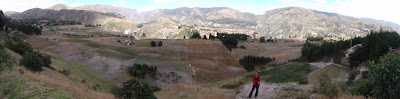 A little boy came up behind us to make sure we knew where we were going. We passed concrete houses with dried grass roofs. Black and white cows dotted the green countryside. We could see the little houses of Chugchilán in the distance where we had left it. We walked along the carretera for a bit until we came to Guyama, a small nothing town with a few crumbling buildings. We are shown two ways to get to the Laguna: the main road and the straight-over-the-mountains dirt path. Guess which one we chose!We passed a school and a few curious little heads poked out of the doorway. We waved with a buenos días. Soon they were running after us asking to take a picture. We oblige by whipping out our camera, but then they wanted some money for the picture. I’m not about to give 30 kids a tip, that’s a lot of money and I don’t like to pay people to take their picture. I put on a pouty face and said, “but you don’t want to take a picture with us without money?” That won them over, because we all knew that they would love to have their picture taken regardless of money. Kids are kids.
 But as soon as we were posed to take the picture, kids flooded out of nowhere! They poured out of the village’s few buildings and started running towards us. Not only kids, but a few adults too! We thank them after a couple pictures and a friendly man walks our way up the narrow dirt path.He points us in the right direction before his path deviates with ours. We continue with smiles. The view far exceeds our expectations! The farmland mountains extend forever and are cut by winding dirt roads. The whole trip is worth it now!
 We’re alone in the countryside. There’s no one within earshot. We come to a few forks in the path and take our chances. Left Right Left Right. Eeny meeny miney moe!Whoops. Our path ends at a cottage. Looks like we took the wrong turn back there. We cut across the fields to join another path. Huh. That one ends too. Oh no. We’re lost. We look around. There’s no one but two men plowing on the next mountain top over. What are we going to do?
 We look around and we are practically alone in the middle of nowhere. We walk around some more and notice a bright red jacket. We cut across potato fields and eagerly join two indigenous women and their vacas. They ask if we need a guide and we say no, a point in the right direction would suffice.We follow their directions, up and down, and finally we find the narrow path that dips into a brief valley. Whew. A sigh of relief follows.That relief is VERY short lived though because in the distance we hear dogs barking. We look and they are sprinting towards us. They sound vicious and we do not want to take our chances so we start running down the path into the valley.We should have known that we would be outmatched. Our lung capacities are far inferior to that of the dogs, especially at that altitude. We make it a few steps and suddenly they are right behind us. I hear them snarling and barking. I know I don’t stand a chance, so before they get too close, I turn and in desperation scream “NO!” at the top of my lungs. My sudden bold action startles them and they back up momentarily. It gives me a chance to gauge the situation. There’s three of them. All pretty big. All pretty unhappy. And is it my imagination or are they spreading out to surround us?!They bare their teeth and snarl. We wave our weapons (our water bottles) and make as much noise as possible while slowly backing away. I am petrified.Nate says we should turn and walk away, losing eye contact. But I don’t want to turn my back, I need to see where they are or else I’m defenseless. Nate picks up a decent sized rock and pushes himself between me and the dogs (what a gentleman!). He tells me to go. I slowly start walking backwards, but I’m not going to leave him there alone.The lead dog gets closer for the attack. It snarls and shows its fangs. The showdown begins. The dog gets closer and closer, barking to show that it means business. Suddenly the dog lunges and gets within a yard of Nate. I scream as it becomes certain that the dog is going to bite Nate. And if it bites Nate, we’d have to get to a hospital. What if it has rabies? What if there is no hospital here in the mountains? What if? What if? What if?!But at that moment, all the fear drains from Nate’s face. He’s ready. His demeanor says, “Bring it, dog! I’m not scared of you. I’ll break this rock over your head!”And I guess the dog sensed that change in Nate and briefly retreated. That’s all the time we needed to back out of the valley. We scrambled up the sandy ascent, hearts pounding and hands shaking. I keep looking back to make sure that they are not following us. Nate says that we have to keep walking. Out of sight out of mind, he keeps repeating.Up and up we climb. My lungs feel like they’re going to explode. I keep stopping to catch my breath, but Nate keeps me going with “venga” and encouragement. My feet keep slipping as we struggle up the hill to the pine forest.
 I keep looking behind me. My adrenaline is still pumping. We run into a large group of French tourists and warn them about the dogs. The have walking poles and power in numbers, so we don’t worry about them.In our paranoid state we keep moving up and up. The view is impressive, but I can’t enjoy it. When my adrenaline runs out, I’m exhausted. The air is thin, but we keep putting one foot in front of the other. I am going really slowly. My ears are trained to the frequency of dog barks.
 Up ahead we see that the road just ends. Could it be?! Nate runs up the sand to the top and looks back with his mouth wide open. We made it! The immense laguna extends below us. It is so much bigger and more magnificent than I had imagined.But the wind had turned bitter and fierce. Our jackets did their best to fend off our fatigue, but the chill crept in and took advantage of our exhausted state. My fingers tingled on the borderline with numb. My cheeks felt sunburnt and feverish. I only thought of getting to the town of Quilotoa for the bus back to Chugchilán. I had no idea how much longer we had.We started walking the rim of the gigantic volcanic lake. The wind threatened to push us over the side of the volcano. I used my last remaining energy to keep my balance. Everything was tired. I just wanted warmth and to rest my tired limbs.
 We followed the path around the laguna. Sometimes we were protected from the wind by the volcanic walls, but sometimes we were out in the open and vulnerable. The clouds were flying overhead at amazing speeds.One. Two. Three sandpatches. We’re almost there. The path forked: right, towards the laguna or left, towards the outside of the volcano. So far we had been going toward the outside to avoid the wind and it had worked out so far for us. But as soon as I said that, a barking dog appeared in the middle of the path. We freaked out and turned to run. I got no more than a few steps in the deep sand. My legs and lungs refused. It was a good thing that this dog wasn’t aggressive. We followed the inside path.
 Up ahead we saw two children! The first people we had seen in maybe an hour! We were overjoyed. We were saved!We met up with the children. They asked for water, we asked for directions. They asked for $1 to take us the rest of the way to Quilotoa. We settled on $.75. My lips were so numb I could barely get my words out.We followed them along the path, relieved to have some direction. It wasn’t that much longer until Quilotoa. We saw buildings and civilization. No more endless, personless hills! We said goodbye to our guides and went in search of the Chugchilán-bound bus.
 We passed basic hostels, tiny stores, and artisan shops. We were torn. I wanted to explore the town and maybe grab a coffee, but we also wanted to make sure that we found our bus. Up until the dog incident, we were considering climbing back down. But now we wanted to find the bus and pronto!There were a few scrappy dogs milling around the town. Ordinarily we wouldn’t have thrown them a second glance, but this time we cowered at the sight of them. Can’t be too careful about dogs!We took shelter in a wooden lodge and waited for the 2pm bus. We did some calculations and figured that we did the 14km hike in 3 hours. At that altitude and that inclination, I think our efforts were impressive.The bus came and we climbed aboard. Dehydrated and exhausted we bounced along the dusty roads, relieved to be sitting down. The bus grunted along the potholed road coming dangerously close to the steep cliff edge. We pulled into Chugchilán and sank into bed around 3:15pm. What a day!
 We snacked on luna and cliff bars (thanks SO much, Mike!), rested, rehydrated, and recounted our adventures. We wondered what had happened to the rest of our pioneering group and hoped, for their sake, that they had turned back and opted for a fourwheeled vehicle. The hike was tougher than we had all thought.We caught up with them during the well needed dinner of quinoa soup, pork, rice and potatoes! They had somehow made it up to the laguna, but the bitter wind forced them back down before they could walk around the rim. So they walked the 14km up the mountain... and 14 km back down! Wow! We didn't even think that they would make it up once, but they outdid us and our expectations! We traded stories and exclamations of relief that we were all back in the warmth of the main cabin. What a great end to a tough day!
 I love it when a river cuts through a valley. And when we’re riding the winding path high up on the mountainside, we can look down at the forcefulness with which the river flows, slicing through the countryside. I love long bus rides so I can stare, wide-eyed, out into the beauty of nature as it glides by the window.
 Cuenca couldn’t come fast enough. We counted down the minutes, but we were still not there! Finally we arrived at the terminal around 7pm. I don’t like arriving to a new city at night. In the taxi, the driver and I chatted it up while Nate and Stephan exchanged stories.
 And it had a spectacular view of Mercado San Francisco and the surrounding iglesias.
 I woke up before the alarm on Tuesday, September 16. The prospect of free coffee propelled me out of bed. The shower was perhaps the best one I’ve had since New York! We went to the market in search of breakfast ingredients. The market was a wonderful cacophony of colors! We walked up and down the aisles past vendors with fresh produce. I got apples, bananas, and yogurt for my granola.
 We also got a white fruit with black seeds and tough green skin. Nate thought it tasted starchy. I thought it tasted like mango, but different.
 We decided to give Cuenca a walkaround. Our feet led us down the cobble stone streets. Izquierda, derecho, derecha. Those were our options. I directed us towards some Inca ruins. We climbed a hill that produced a decent view, but never found those ruins.
 Lunch was leftover soup, which was pretty good the second time around. I looked up the mysterious Inca ruins on my LP map and realized that I had misinterpreted it! We had gone walking in the completely opposite direction! Go figure.
 We passed trendy shops, tiny restaurants boasting almuerzos, churches, supposed New York Pizza, lots of banks, a few parques, standstill traffic, pirated DVD shops and a few security guards with machine guns. But no café with WIFI. We spent hours searching for one, just one, but to no avail. Let this serve as an explanation for why you are receiving so many blog posts so late!
 Dinner was undercooked and underseasoned beans (we were hungry and impatient!), rice, veggies and fresh bread. We struck up a conversation with travelers in the kitchen. I was wiped out for no good reason at all, so I fell easily asleep.


